
Your curtains are on the wrong side of the glass
13 November 2026

Most Dubai homes fight the sun from the wrong side of the glass. By the time an indoor curtain or blind catches the afternoon sun, the heat is already in the room, and your air conditioning has to remove it.
In the UAE, cooling is the single biggest call on a home's electricity. Buildings use almost 80% of the country's electricity, and air conditioning accounts for 60–70% of the electricity used in buildings. Yet most of us still treat shading as something for the garden, not as part of how we cool the house.
This article looks at what the research actually shows about outdoor blinds and awnings, why where you stop the sun matters more than how, and which products suit which parts of a Dubai villa.
How the sun heats a room
Sunlight heats a room in two ways, and both start at the window.
- Straight through the glass. Most of the heat arrives as sunlight that passes through the pane, lands on floors, sofas and walls, and turns into heat. Glass lets sunlight in easily but holds the resulting heat inside.
- By heating the glass itself. The pane absorbs part of the sun's energy, warms up, and radiates that heat into the room.
An indoor curtain or blind sits behind the glass, so the heat has already arrived. The fabric warms up and gives off heat into the room. It helps with glare, but only partly with temperature.
An outdoor blind or awning stops the sun before it reaches the glass. The fabric warms up outside, where the breeze carries the heat away. Less heat gets in, so the AC has less to remove.
Tinted or reflective glass alone is not the answer here. Simos Yannas of the Architectural Association School of Architecture in London, who studied buildings in Dubai and Abu Dhabi, puts it plainly: in this climate every window, on every side, needs "fixed and/or movable external shading", and controlling the sun with the glass alone "is insufficient".
Engineers measure this with a g-value: the share of the sun's heat that makes it through a window. A lower g-value means a cooler room.
What the research says
Independent studies agree: outdoor shading cuts cooling far more than indoor shading, typically by around 10% to 20% for a home and much more on the worst-facing windows.
| Study | Where | What was tested | Key finding |
|---|---|---|---|
| Lund University, 2003 | Sweden, real-climate test boxes | Awnings, screens and blinds, inside vs outside the glass | Outdoor products let through about 0.3 of the sun's heat, indoor about 0.6; outdoor is roughly twice as good at cutting peak cooling |
| PNNL for the US Department of Energy, 2020 | Two identical test homes, Washington State | Outdoor fabric screens on west- and south-facing glass | About 20% less AC energy than bare glass, 10% less than indoor blinds; rooms up to 9°F (5°C) cooler with the AC off |
| ES-SO 2014 study | Simulations across Europe | Motorised (dynamic) shading | Average cooling savings over 36%, rising to 65–70% on south-west façades |
| UAE University, 2021 | Villa in Al Ain, model checked against real bills | Outdoor shading structure | About 10% less energy, roughly AED 2,400 a year |
| Architectural Association, London (Yannas), about 2008 | Dubai and Abu Dhabi climate, computer simulation | Window size and orientation, insulation, night cooling, then shading that keeps direct sun off the glass | Shading cut the remaining cooling energy by about two-thirds with large windows, half with medium and a third with small; east- and west-facing windows needed 11–17% more cooling than north and south |
| PAMA Awning Energy Study II | Simulations, 50 US cities | Fixed and drop arm awnings vs outdoor roller screens | Awnings saved 17–72% of cooling, roller screens up to 33% |
Two honest caveats. Most of this research comes from cooler climates than ours (the Architectural Association study is the exception, though it set the air conditioning to 29°C, so look at its percentages rather than its totals), so the percentages are a guide rather than a promise for a Dubai villa. And the PAMA study, funded by the awning industry, found awnings outperformed roller screens across the US. The next section explains why that changes in Dubai.
Why west and east glass matter most in Dubai
In a Dubai summer, the hardest-working windows face west and east, not south. Dubai sits at about 25° north, close to the tropics.
- Midday: in June the sun is almost directly overhead. South-facing walls get little direct sun, and any roof overhang shades the glass easily.
- Afternoon: the sun drops low in the west just as the air is at its hottest. It shines almost straight into west-facing glass for hours.
- Morning: the same happens on east-facing glass, earlier and less intensely.
The Architectural Association's simulations for Dubai and Abu Dhabi found the same: an identical building needed 11–17% more cooling energy when its windows faced east and west rather than north and south.
This is where the type of shade makes a difference. An awning projects outwards, so it works brilliantly when the sun is high. When the sun is low, its rays slip underneath the front edge and around the sides and reach the glass. A screen that drops vertically down the face of the window blocks the sun at any angle, including the last two hours before sunset.
Try it on the villa below, a Springs Type 4E with its garden facing west: an Arond awning over the kitchen window, and a Maxiscreen on the dining bay's sliding door. Move the time through a June day. At midday the awning shades its window completely, but from late afternoon the low sun slips under it and reaches the glass. The door behind the screen stays shaded all day; raise the screen to see how much sun it would get without it.
Loading the 3D villa…
Drag to turn the villa
What the 3D villa shows
An interactive 3D model of a Springs Type 4E villa in Dubai, with the sun following Dubai's real sun path (25° N) on 21 June or 21 December. The kitchen window has an Arond retractable awning; the dining bay's sliding door has a Maxiscreen outdoor screen. Visitors move the time of day, turn the garden to face west or east, raise or lower the screen, and see the share of each glass area in direct sun, worked out from the sun's position. Results with the garden facing west in June:
- Midday to 16:00: no direct sun on the kitchen window; the high sun is stopped by the awning.
- Late afternoon: the low western sun slips under the awning and reaches the window: about 14% of the glass at 17:00 and about 30% at 18:00.
- Behind the lowered screen the sliding door gets no direct sun all day. With the screen raised, the door is in full sun at 17:00 (100%) and about 60% at 18:30, when the garden wall starts to shade it.
The point: an awning works well when the sun is high, but low sun on west and east facing glass gets under it; a vertical outdoor screen stops the sun at any angle, before it reaches the glass.
So the honest rule is not "blinds beat awnings". It is: awnings for high sun and outdoor living, vertical screens for low sun on west and east glass.
Choosing the right product
Match the product to the window and the sun it faces. All three below are made by Llaza in Spain, run manually or with Somfy motors, and fit outside the glass.
| Product | Best for | How it shades | Worth knowing |
|---|---|---|---|
| Maxiscreen (blind or box) | Windows and sliding doors on west and east façades | Drops vertically down the face of the glass, guided by a cable each side | Our go-to window screen for cutting heat; a small gap at each side lets a sliver of light past |
| Zip Screen 500 | Large glass, terraces and pergolas facing the afternoon sun | Fabric locked into side channels, so no gaps at the edges | Seals out wind, dust and insects too, and can fully enclose a terrace |
| Drop arm awning | Individual windows where you want shade with some airflow and view | Arms angle the fabric out from the wall, up to 180° | Up to 5m wide with 1.4m projection; angled steeply, it blocks lower sun than a flat awning |
What the screen fabric does with the sun
The fabric is where the heat is stopped. We use Sauleda Screen 40, a 5% open screen fabric (72% PVC, 28% polyester). Sauleda tests how much of the sun's energy each colour lets through, reflects and absorbs:
| Colour | Sun's energy through the fabric | Reflected | Absorbed | Daylight through |
|---|---|---|---|---|
| White | 18% | 70% | 12% | 15% |
| Optik | 17% | 68% | 15% | 13% |
| Sand | 22% | 57% | 21% | 19% |
| Beige | 20% | 52% | 28% | 16% |
| Pearl | 12% | 49% | 39% | 9% |
| Alu | 13% | 41% | 46% | 10% |
| Iron | 9% | 33% | 58% | 7% |
| Metal | 6% | 14% | 80% | 6% |
| Bronze | 3% | 7% | 90% | 3% |
| Black | 5% | 4% | 91% | 5% |
Whatever the colour, only 3% to 22% of the sun's energy passes through the fabric. Light colours bounce most of the rest back; dark colours absorb it and warm up. Outside the glass that doesn't matter much, because the warm fabric gives its heat to the outside air. Indoors, the same warm fabric would be giving its heat to your room.
Screen fabrics also keep your view. They are an open mesh that lets you see out while blocking most of the sun's heat. In the US Department of Energy field test, every homeowner said seeing outside with the screen down was the feature they liked most. Indoors, the fabrics that block the most heat tend to block the view and most of the daylight too.
Make it automatic
An outdoor screen only saves energy when it is down while the sun is on the glass. In the US Department of Energy field homes, owners kept their screens closed only about 4 to 5 hours a day, and mostly when the glare bothered them. Automation removes the guesswork.
With a Somfy motor on your screens or awning, you can choose how much to automate.
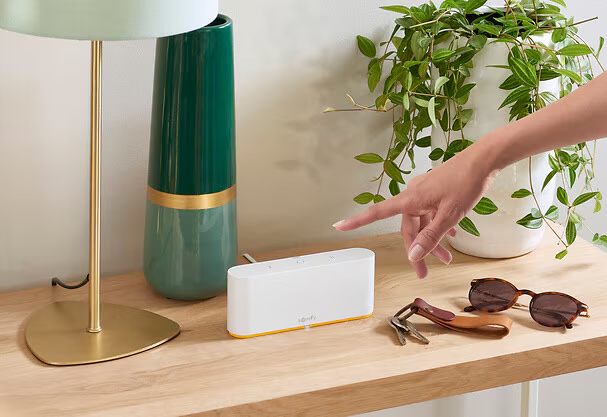
Somfy TaHoma Switch
Connects your motorised screens and awnings to your home Wi-Fi. Open and close them from your phone, wherever you are, set schedules (for example, west screens down from 1 pm every day in summer), create scenes for the whole house, and use voice control through Alexa or Google Assistant. It is also the hub the two sensors below work through.
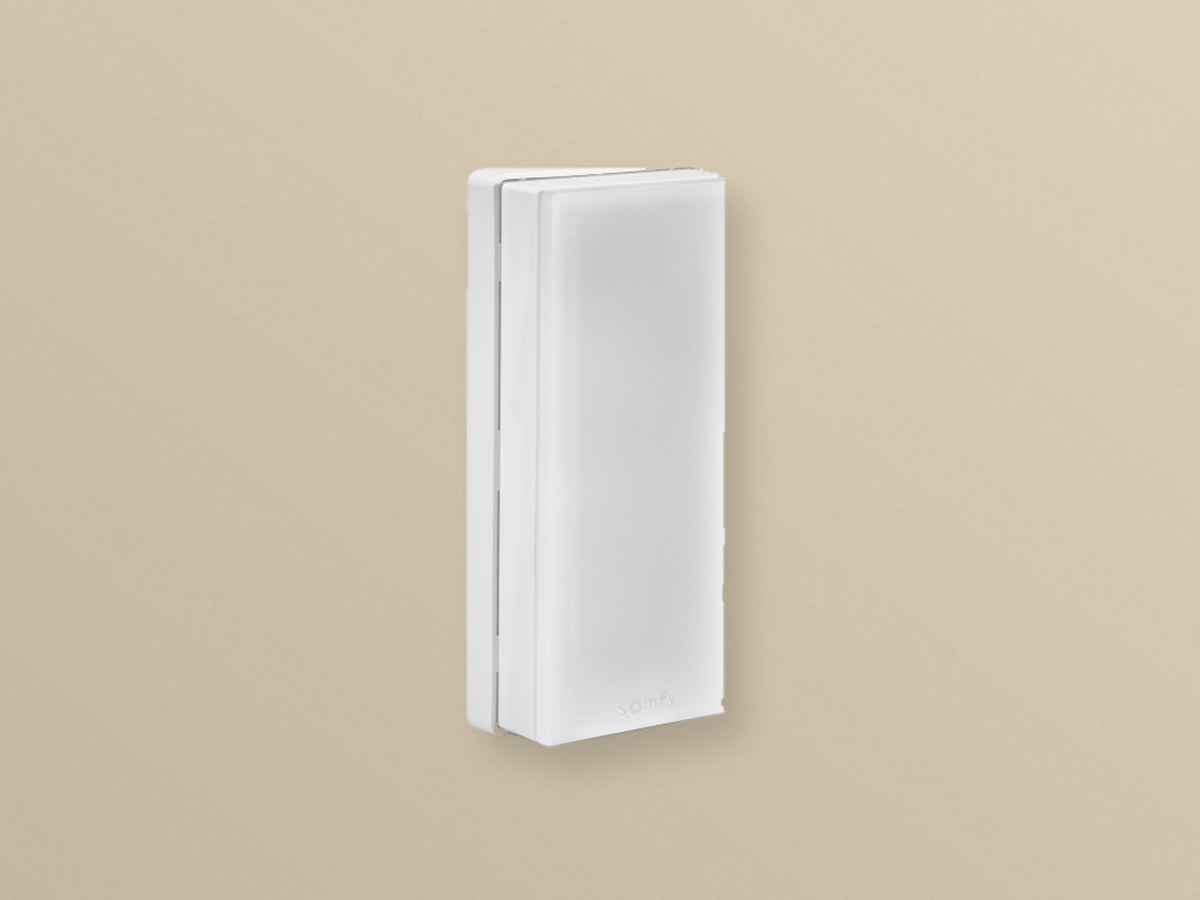
Somfy Sunteis io sensor
Sits outside and measures sunlight and outdoor temperature. When the sun gets strong, it lowers your screens or extends your awning; when the sun fades, it raises them. It is solar powered, so there are no batteries to change.
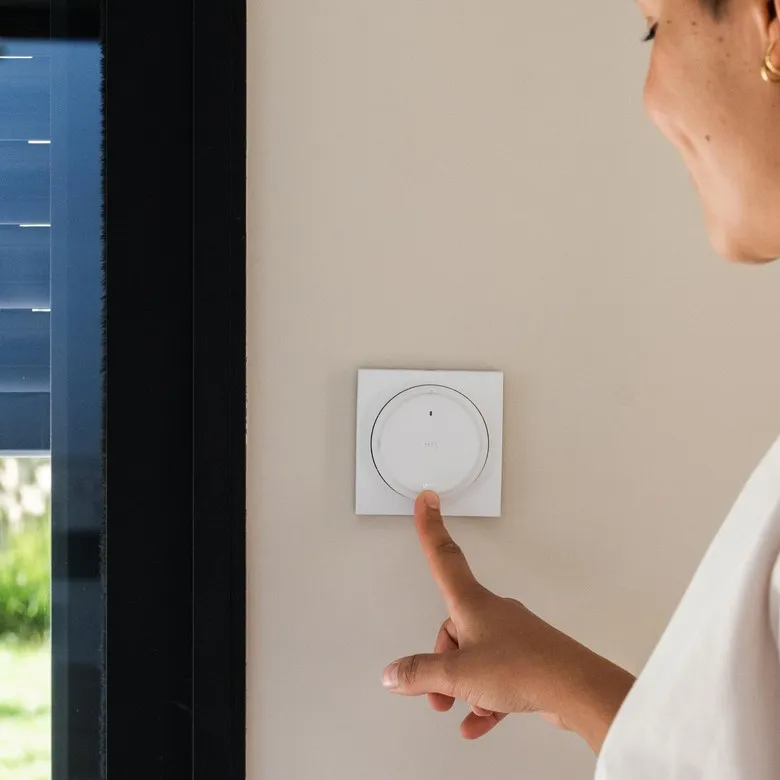
Somfy Amy io wall switch
Measures the temperature inside the room. When the room passes the temperature you set, it closes the screens, even on hazy days when a light sensor might not react. It is wireless, so it needs no new wiring.
All of them keep working when you are out, so you come home to a cooler house. For the best results, give each sunny side of the house its own sensor or room switch: your west screens should respond to the afternoon sun, not the morning sun on the east.
The bottom line
The sun's heat comes in through your glass, and it is best stopped on the outside. Indoor curtains help with glare; outdoor screens and awnings cut the heat your AC has to fight.
Three steps make the biggest difference in a Dubai villa:
- Start with the west-facing glass, then the east.
- Use vertical screens such as Maxiscreen or Zip Screen where the low afternoon sun hits; use awnings for high sun and outdoor living.
- Add a Somfy TaHoma Switch, sensor or Amy io switch so the screens are down whenever the sun is on the glass.
Send us a photo of your west- or east-facing windows on WhatsApp or call 04 379 7844, and we will recommend the right shade. You can also see the screens and fabrics at our showrooms in Al Quoz, Dubai and Musaffah, Abu Dhabi.
Sources
- Bülow-Hübe, Kvist and Hellström, Estimation of the performance of sunshades using outdoor measurements, Lund University, 2003
- Hunt and Cort, Evaluation of Exterior Shades at PNNL Lab Homes and Occupied Field Sites, Pacific Northwest National Laboratory for the US Department of Energy, 2020
- ES-SO, A new vision on solar shading, summarising the ES-SO 2014 study
- Bande et al., Parametric Design Structures in Low Rise Buildings in Relation to the Urban Context in UAE, Sustainability, 2021
- Yannas, Re-conceiving the Built Environments of the Gulf Region: Challenging the Supremacy of Airconditioning, Architecture & Art, about 2008, pp. 20–43 (ResearchGate)
- Sauleda, Screen 40 technical specifications (solar values per colour)
- Khalifa University (Masdar Institute research), How to Make Buildings More Energy Efficient (buildings use almost 80% of the UAE's electricity)
- Middle East Construction News, Department of Energy launches Cooling Load Manual, July 2026 (air conditioning 60–70% of electricity use in UAE buildings)
- Sahlin, Awnings provide cool solutions for homeowners, on the PAMA Awning Energy Study II, 2012
More articles


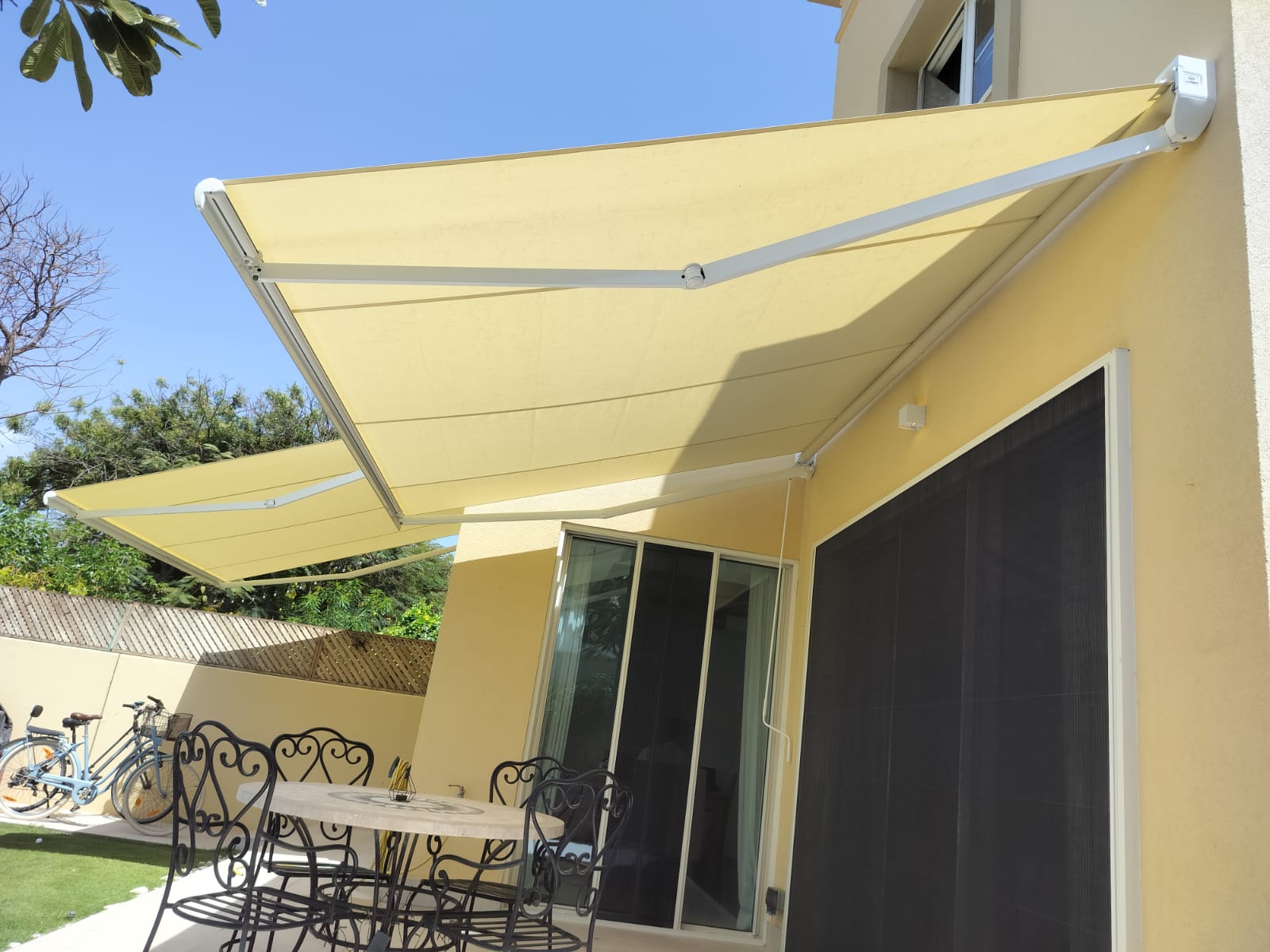
Get a quote for your project
Tell us about your space and we'll recommend the right shade, with a price and installation date.